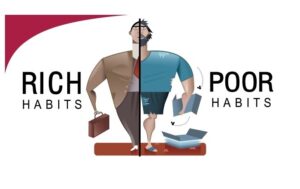
If you find value in these articles, please share them with your inner circle and encourage them to Sign Up for my Rich Habits Daily Tips/Articles. No one succeeds on their own. Thank You!
TOM@RICHHABITS.NET
- They saved 10% or more of their income.
- They read educational material every day.
- They exercised regularly.
- They set written goals and pursued them with obsession.
- They surrounded themselves with other success-minded people.
- They worked long hours and often went far beyond what their jobs required.
- Many failed in business at least once and kept going.
The 41% who came from poverty did not allow their poverty to hold them back.
The 59% who came from the middle class did not treat comfort as a finish line.
Both groups treated their starting point as a launchpad. They rejected the idea that their financial future was already decided by the circumstances of their birth.
- Nearly 90% believed most rich people inherited their money.
- Nearly 90% believed fate or outside forces dictated their financial circumstances.
- Seventy-nine percent wanted the government to do more to help them financially.
Those beliefs correlated with very different daily choices:
- Regularly playing the lottery.
- Funding their standard of living with credit-card debt.
- Absence of reading to learn, grow and improve.
- Zero Saving rate.
The self-made millionaires I studied lived an opposite set of beliefs – 100% of the self-made believed accumulating wealth was a central part of the American Dream. They rejected the idea that the Dream was no longer possible. Their results followed their beliefs and their habits.
I did not conduct this research to scold anyone. I conducted it to answer two simple questions:
- Why are some people rich and others poor? And
- What do they actually do with their time every day?
After examining more than 300 categories of behavior, thinking, choices and decisions, the pattern is unmistakable. Starting points matter, but they are not decisive. Daily habits compound over years and decades. The people who rose from middle-class and poor homes proved that upward mobility is still real for those willing to adopt the habits that create upward mobility.
Rich Habits, not the Government, are your best shot at escaping poverty or the middle class.
The privilege narrative merely offers an emotional blanket to cover yourself with and a readily available crutch to rationalize inequality.
The data from 177 self-made lives offers something harder and more useful: evidence that ordinary people from ordinary or difficult backgrounds can still build extraordinary wealth. Fifty-nine percent middle-class. Forty-one percent poor. Zero percent inherited.
The numbers do not care about ideology. They simply reflect reality.
