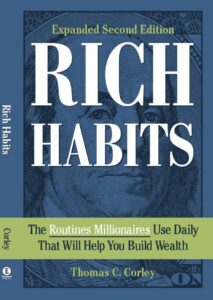
Tom Corley is the author of the Rich Habits Study, “Rich Habits”, Rich Kids”, “Effort-Less Wealth”, “Change Your Habits Change Your Life”, “Rich Habits Poor Habits”, and “Rich Habits Wealth Academy”. Tom is also a CPA, CFP®, and has a Masters in Taxation.
Most people believe the wealthy simply work longer hours or get lucky. My five-year Rich Habits Study of 233 wealthy individuals (177 of them self-made millionaires) and 128 people living in poverty shows something different. Many of the poor worked long, hard hours. The real divider was not raw effort. It was what the self-made rich did with a specific block of time every single day that the poor consistently refused to do.
That one thing is deliberate, daily self-education through reading.
- 88% of the self-made millionaires in the study spent at least 30 minutes every day reading material that made them better at their work or helped them achieve their goals—books on their industry, biographies of successful people, self-improvement, or career-related content.
- Only 2 percent of the poor did the same.
- 77 percent of the poor spent more than an hour a day watching television, scrolling, or consuming fiction.
While one group treated part of each day like an investment in their future capability, the other treated the same hours as entertainment.
This was not occasional reading. It was a daily habit, repeated year after year. Many of the self-made also read two or more nonfiction books per month. They used commute time for audiobooks and podcasts.
They treated learning as non-negotiable, the same way others treat a morning coffee. The result was continuous skill improvement, better decision-making, and growing expertise that compounded into higher income and better opportunities.
The poor were not less intelligent.
- 41% of the self-made millionaires in the study had grown up poor. What separated them was the refusal to waste the same 24 hours everyone receives. The self-made treated their days like a business.
- 80% of the self-mades focused on goals daily and wrote their goals down.
- 94% of the self-mades saved 20 percent or more of their net income, avoided consumer debt, and built multiple income streams.
But the daily reading habit stood out as one of the clearest, most consistent differences. It fed the other habits. Reading supplied ideas, models, and knowledge that made goal pursuit, saving, and skill-building more effective.
This habit also created a ripple effect. Continuous learning improved competence, which boosted confidence, and opened doors to better networks and opportunities. It reduced the need to rely solely on longer hours at a single job.
In my Rich Habits Study, many of the wealthy eventually built assets—businesses, investments, skills—that generated passive income.
The poor, by contrast, often remained stuck trading time for money while filling free hours with entertainment or recreational activities that allowed them to escape from their life of drudgery.
The good news is that this one daily Rich Habit, reading to learn, is available to almost anyone. You do not need a trust fund or a high-powered job to start. Replace 30 minutes of television or scrolling with purposeful reading. Choose material tied to your work, a skill you want, or a goal you are pursuing. Do it at the same time each day until it becomes a habit.
The self-made millionaires who came from poverty did not receive special exemptions. They simply stopped doing what the poor in their inner circle did and started doing what the rich did every day.
Habits are the cause. Financial circumstances are the effect. The data from the Rich Habits research is clear: the wealthy did not outperform primarily because they worked harder in the conventional sense. They performed one small, consistent action—daily self-education through reading. Over years, that single difference helped them build wealth and competence.
