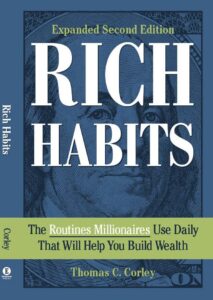
Tom Corley is the author of the Rich Habits Study, “Rich Habits”, Rich Kids”, “Effort-Less Wealth”, “Change Your Habits Change Your Life”, “Rich Habits Poor Habits”, and “Rich Habits Wealth Academy”. Tom is also a CPA, CFP®, and has a Masters in Taxation.
Wealth is not a mystery or a matter of pure luck. It rests on three practical foundations: creating excess income, consistently investing that excess, and keeping what you build. These pillars, drawn from my five-year Rich Habits research of 233 wealthy individuals and 128 people living in poverty, plus supporting data from sources like Forbes, the IRS, the Census Bureau, and the Federal Reserve’s Survey of Consumer Finances, explain why some people accumulate lasting wealth while others do not.
Foundation #1: Creating Excess Income
Excess income is the gap between what you earn and what you spend. In a nutshell, what you spend depends upon your standard of living – how much it costs to allow you to fund your lifestyle.
Without excess income to save, there is nothing to invest. In my Rich Habits Study, one way the self-made rich created excess income is by creating multiple streams of income – 65% of the wealthy in my Rich Habits Study created and managed three or more income streams—such as real estate rentals, part-time ventures, or passive investments—while only 5% of the poor did so.
A 2019 Forbes analysis noted that 45% of millionaires have at least two income sources, and IRS data shows high-income households often derive around 30% of their income from investments rather than wages alone.
Another way to create excess income is to save 20% or more of your income and force yourself to live off of the remainder. In effect, you create a lifestyle that allows you to save.
You create excess by aligning with one of four paths suited to your personality:
- Saver-Investor – live on 80% or less of your income and save the rest.
- Big Company Climber – Excess income is typically created through executive compensation packages that include bonuses, stock or stock-related compensation and incentive stock options.
- Virtuoso – master a high-value skill which is so valued that society pays you a premium for your knowledge or skills.
- Entrepreneur/Dreamer. Pursue some dream that can be monetized. The entrepreneurs in my Rich Habits Study had the highest income and greatest wealth. They typically created multiple streams of income around their core business.
Foundation #2: Consistently Investing That Excess Income
High incomes alone do not create wealth; consistent investing does. In my research, 79% of millionaires invested regularly, often in low-cost index funds or real estate, and 66% of Saver-Investors lived on 80% or less of their income. The typical Saver-Investor accumulated roughly $3.3 million over an average of 32 years by saving 20% or more of net pay and investing it prudently. Automation is key: treat the 20% as the first “bill,” directing it automatically into retirement accounts and brokerage accounts so lifestyle spending cannot touch it.
Compounding turns consistent investment of savings into exponential growth. Federal Reserve Survey of Consumer Finances data and related analyses confirm that disciplined savers and investors, not just high earners, drive most household wealth accumulation over decades. Start small, stay consistent, and avoid interrupting the process. Time in the market, not timing the market, is the proven advantage.
Foundation #3: Keeping Your Wealth
Creating wealth is only part of the equation; keeping it is the other part. Lifestyle creep—raising spending to match rising income—destroys more wealth than market crashes. My research and Census Bureau data show roughly 30 million people earn more than they need yet remain one paycheck from hardship because of excess spending. Celebrities and ordinary high earners alike have gone broke by “want spending” on status items they do not need.
Self-made millionaires in the study avoided this by maintaining a frugal mindset: buying modest homes, used cars, coupon use, and prioritizing savings over peer-pressure consumption. Business Insider coverage of these habits and Federal Reserve insights on higher-income households underscore that living below your means and protecting assets (via wills, tax-efficient accounts, insurance and diversified holdings) preserve wealth.
Optimal wealth for most people falls in a range that reduces financial worry without creating endless complexity—roughly $3–15 million in my findings, with around $6 million as the optimal amount of wealth.
These three foundations work together. Create the excess, invest it automatically and consistently so compounding works, and protect it from lifestyle creep and poor decisions.
